Google Lens for Plant Nursery Owners: How to Get Found in Visual and AI Search
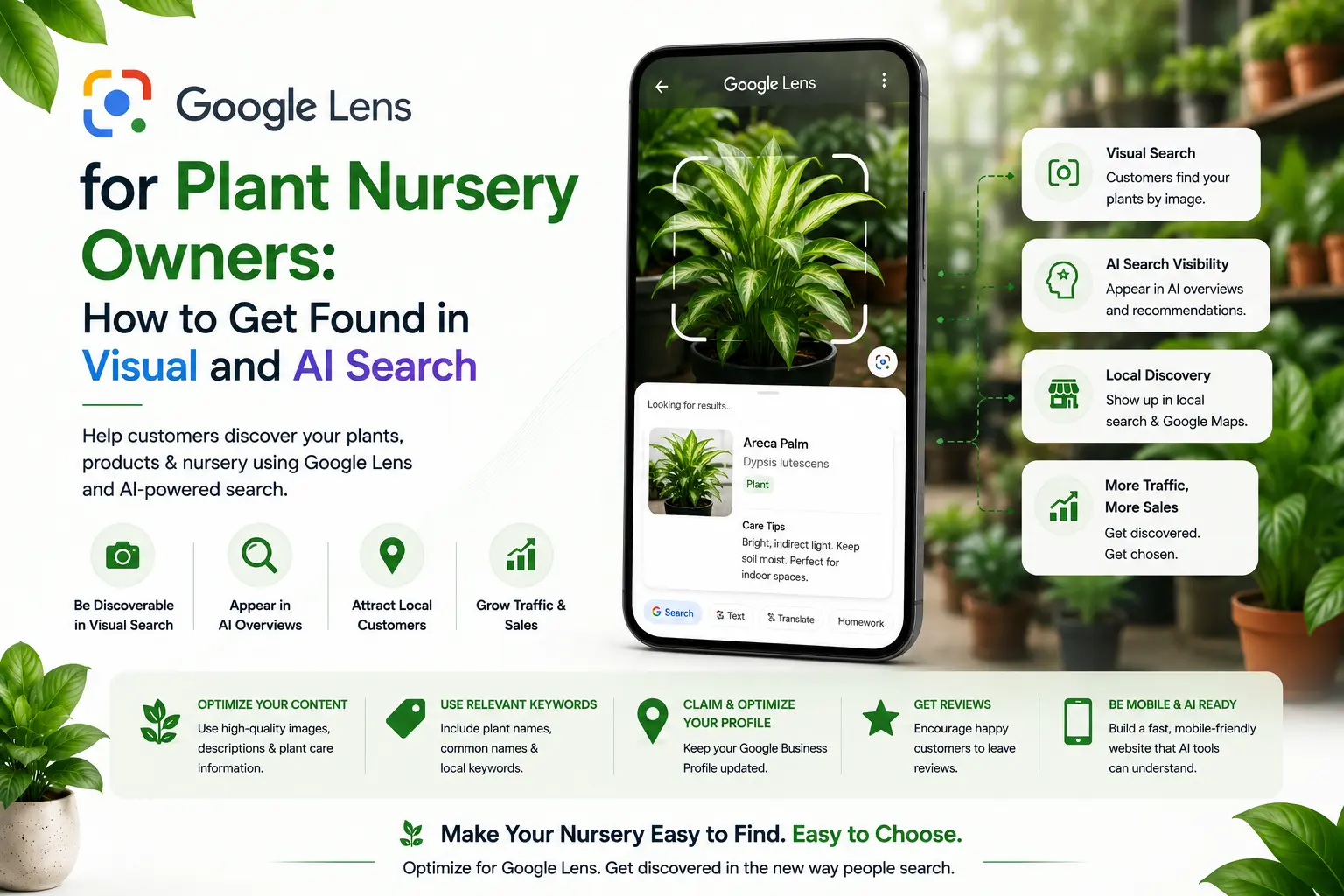
A customer sees a plant they love at a friend's house. They do not know what it is called, so they do not type anything. They lift their phone, take a photo, and let the camera do the searching. Seconds later they are looking at a name, a care guide, and a list of places to buy it.
The question every nursery owner should be asking is simple. When that happens, does your business appear in those results, or does someone else sell the plant you already have sitting in your polytunnel?
Why Visual Search Now Decides Which Nurseries Get Found
Typing is no longer the only way people search, and for plant businesses it may not even be the main way for much longer. Google Lens turns any phone camera into a search bar, and plant identification is one of the things it does best.
The Numbers Behind the Shift
- Google Lens now handles roughly 20 billion visual searches every month, and around 4 billion of those are shopping related.
- Amazon has reported a 70 percent year on year rise in visual searches worldwide.
- Around 58 percent of the top 500 ecommerce retailers have already built or are actively testing visual search.
- Traffic reaching US retail sites from AI sources grew 393 percent year on year in the first quarter of 2026, according to Adobe Analytics data reported by TechCrunch .
- That AI traffic converted 42 percent better than ordinary traffic in March 2026, a full reversal of where things stood a year earlier.
Adobe also found that a large share of retail pages are simply not machine readable. The content is there for humans, but a search engine or a language model cannot parse it. That is the gap this guide closes.
Why This Hits Plant Businesses Hardest
Most retailers sell things people can name. A customer knows they want running shoes or a cordless drill. Plants are different. Shoppers routinely want something without knowing what it is called, and the barrier between wanting and buying is identification.
Visual search removes that barrier completely. That is enormous for your sales, but only if your stock is visible at the moment of identification. If it is not, the camera hands your customer to a large online retailer instead.
What Happens When Someone Photographs a Plant
Understanding the sequence makes it obvious where nurseries fall out of the journey.
| Stage | What the shopper does | What decides whether you appear |
|---|---|---|
| Capture | Photographs the plant | Nothing. This part is out of your hands |
| Identify | Sees a species name returned | Whether your images are indexed and correctly labelled |
| Explore | Scrolls shopping and information results | Product structured data and a product feed |
| Choose | Picks a seller | Reviews, price, delivery promise, page speed |
| Buy | Orders or drives to the shop | Checkout quality and live arrival guarantees |
Most nurseries lose the customer between stage two and stage three. The plant gets identified correctly, and then the shopping results show everyone except the local grower who has forty of them in stock.
Five Reasons Your Plants Are Invisible to a Camera
1. Your Image Filenames Say Nothing
A photo saved as IMG_4471.jpg carries no meaning. Search engines read filenames as a signal, and a file named ficus-elastica-rubber-plant-6-inch-pot.jpg tells them exactly what they are looking at.
2. Your Alt Text Is Missing or Generic
Alt text was built for accessibility and it remains the clearest description a machine gets of an image. Google's own image SEO documentation treats it as a primary signal. Writing "plant" helps nobody. Writing "Monstera deliciosa in a 20cm nursery pot, split leaves, indoor foliage plant" helps everyone.
3. You Use Only Common Names
Common names change from street to street. Botanical names do not. If your product pages carry only the local name, you are invisible to every search that starts from a correct species identification, which is exactly what a camera returns.
4. You Have No Product Structured Data
Structured data is the label on the tin. Without it, a machine has to guess at your price, stock status and pot size. With it, those details are handed over cleanly. This is the single biggest technical gap on nursery websites.
5. Your Images Load in a Way Machines Cannot Read
Galleries built purely in JavaScript, images hidden behind sliders, and lazy loading configured badly all mean a crawler arrives and finds nothing. Your customers see beautiful photos. Search engines see an empty page.
How to Make Your Nursery Readable by Machines
Name Every Plant the Way a Botanist Would
Every product page should carry the botanical name alongside the name your customers actually use. Plants of the World Online from Kew is a free reference for getting genus, species and cultivar right.
Common Name Differences Across India, the UK and the US
This is where most nurseries selling to more than one market lose traffic without ever realising it.
| Botanical name | India | United Kingdom | United States |
|---|---|---|---|
| Epipremnum aureum | Money plant | Devil's ivy | Pothos |
| Dracaena trifasciata | Snake plant | Mother in law's tongue | Snake plant, Sansevieria |
| Ficus elastica | Rubber plant | Rubber plant | Rubber tree |
| Murraya koenigii | Curry patta | Curry leaf | Curry leaf tree |
| Coriandrum sativum | Dhania | Coriander | Cilantro |
Carry the botanical name in your page title and heading, then list the regional names in the description and in your structured data. One page can then serve buyers in all three markets.
Add Product Structured Data to Every Plant Page
Follow Google's product structured data guidelines and the schema.org Product specification . Living stock needs a few fields that generic retail advice never mentions.
The Fields That Matter for Living Stock
| Field | What to put in it | Why it matters for plants |
|---|---|---|
| name | Common name plus botanical name | Matches both typed and camera searches |
| alternateName | Regional common names | Captures buyers in other markets |
| image | Several real photos of your actual stock | Stock photos rarely match a customer's camera |
| availability | InStock, OutOfStock or PreOrder | Seasonal stock changes weekly and must stay honest |
| additionalProperty | Pot size, mature height, light needs, hardiness | These are the details buyers filter on |
| aggregateRating | Genuine customer reviews | Strong trust signal for a living purchase |
Get Your Stock Into the Google Shopping Graph
Visual shopping results are drawn from an enormous product index. Getting listed starts with a product feed through Google Merchant Center . Free listings are available, so this is a visibility channel most independent nurseries can access without an advertising budget.
Write Care Content That AI Can Quote
You answer plant care questions every single day. Written down properly, those answers become the content that AI assistants cite when someone asks which plant suits a shaded balcony.
The Answer First Format
- Ask the question as a heading, in the words a customer would use.
- Answer it in the first two sentences, plainly, with no build up.
- Then expand with detail, seasonality and your own regional experience.
- Add FAQ structured data so the format is unmistakable.
Local knowledge is your advantage here. No national retailer can tell a customer what survives a Kolkata summer, a Yorkshire winter or a Texas drought. You can.
The Ten Minute Test You Can Run Today
Before you change anything, find out where you actually stand.
- Pick your three best selling plants.
- Photograph each one on your own site, on a plain background, in good light.
- Open Google Lens and search each photo.
- Check whether the species comes back correctly.
- Scroll to the shopping results and look for your nursery.
- Write down which sellers appear instead of you.
How to Read the Results
- Wrong species returned. Your photography needs work before anything else.
- Right species, no shopping results at all. There is no product feed behind your catalogue.
- Right species, competitors listed, you missing. Your pages lack structured data. This is the most common outcome and the quickest to fix.
Visual Search and Local Search Work Together
Visual search tells someone what a plant is called. Local search tells them where to get it. You need both, because a shopper who identifies a plant and then searches for it nearby is one of the most valuable customers you will ever get.
If you have not covered the local half yet, start with my guide on how to rank for plant nursery near me , which walks through Google Business Profile, reviews and location pages. Speed matters across both, and Google measures it through Core Web Vitals .
What I Would Build for Your Nursery
I keep a garden and an aquarium, so I am building for a customer I already am. Here is what usually needs fixing, and what I put in its place.
| The gap | What it costs you | What I build |
|---|---|---|
| Unlabelled images | Invisible to every camera search | Botanical naming across filenames, alt text and headings |
| No structured data | Absent from visual shopping results | Full product schema tuned for living stock |
| No product feed | Never enters the shopping index | Merchant Center setup with free listings |
| Catalogue built in JavaScript only | Crawlers arrive and find nothing | Server rendered pages in Next.js |
| Care knowledge locked in your head | No authority for AI to cite | An answer first content engine, partly automated |
I have built exactly this kind of structured, automated system before. Hamarakhet is an AI powered platform for Indian farmers with an automated content engine running on a near zero cost stack, and you can see the wider build quality across my recent projects . For the bigger picture on growing a plant business online, read how I grow plant nursery and aquarium businesses .
Frequently Asked Questions
Does Google Lens work for a plant nursery in India, the UK and the US?
Yes. Lens identifies plants the same way everywhere. What changes is the common name your customers use, so your pages need the botanical name plus the regional names for each market you sell into.
Do I need an online shop to appear in visual search?
No. A well structured catalogue page with product data and honest stock status can appear even if customers buy in person. An online shop simply captures more of the demand.
How long does it take to show up after making these changes?
Structured data is usually picked up within a few weeks once pages are crawled. Product feeds can appear faster. Photography and content improvements compound over a season.
Is this worth doing for a small nursery?
Especially for a small nursery. Large retailers already have feeds and schema in place. This is one of the few areas where an independent grower can appear beside them for the price of doing the work properly.
Start Showing Up When the Camera Comes Out
Your customers have already changed how they search. They point, they shoot, and they buy from whoever the results hand them. Botanical naming, product structured data, a clean feed and content worth quoting are what put your nursery in that list.
Run the ten minute test first. If your plants are not coming back, claim a free website audit and I will photograph three of your bestsellers, show you exactly what Google returns, and tell you the three highest impact fixes. You can also get in touch to have a nursery website built to be found by both people and machines.
Want a website that actually ranks & converts?
Book a free 30-minute strategy call. No pitch — just a clear plan for your traffic, design, and conversions.