Why Legal Pages Matter for Ecommerce and SaaS Companies?
Search for legal pages for websites and you will land on a lawyer's blog, a legal template store, or a document generator trying to sell you a bundle. That content is useful for the words on the page. It rarely covers what happens after the words are written: where the page lives, whether your cookie banner actually works, whether it is indexed correctly, and whether these pages are quietly helping or hurting your conversion rate. That is the part we deal with as the people who build the site, not draft the contract, and it is the part missing from almost every guide on this topic. This one also covers something most legal-page content skips entirely: the actual enforcement numbers for 2026, so you know what non-compliance really costs, not just that it is theoretically risky.
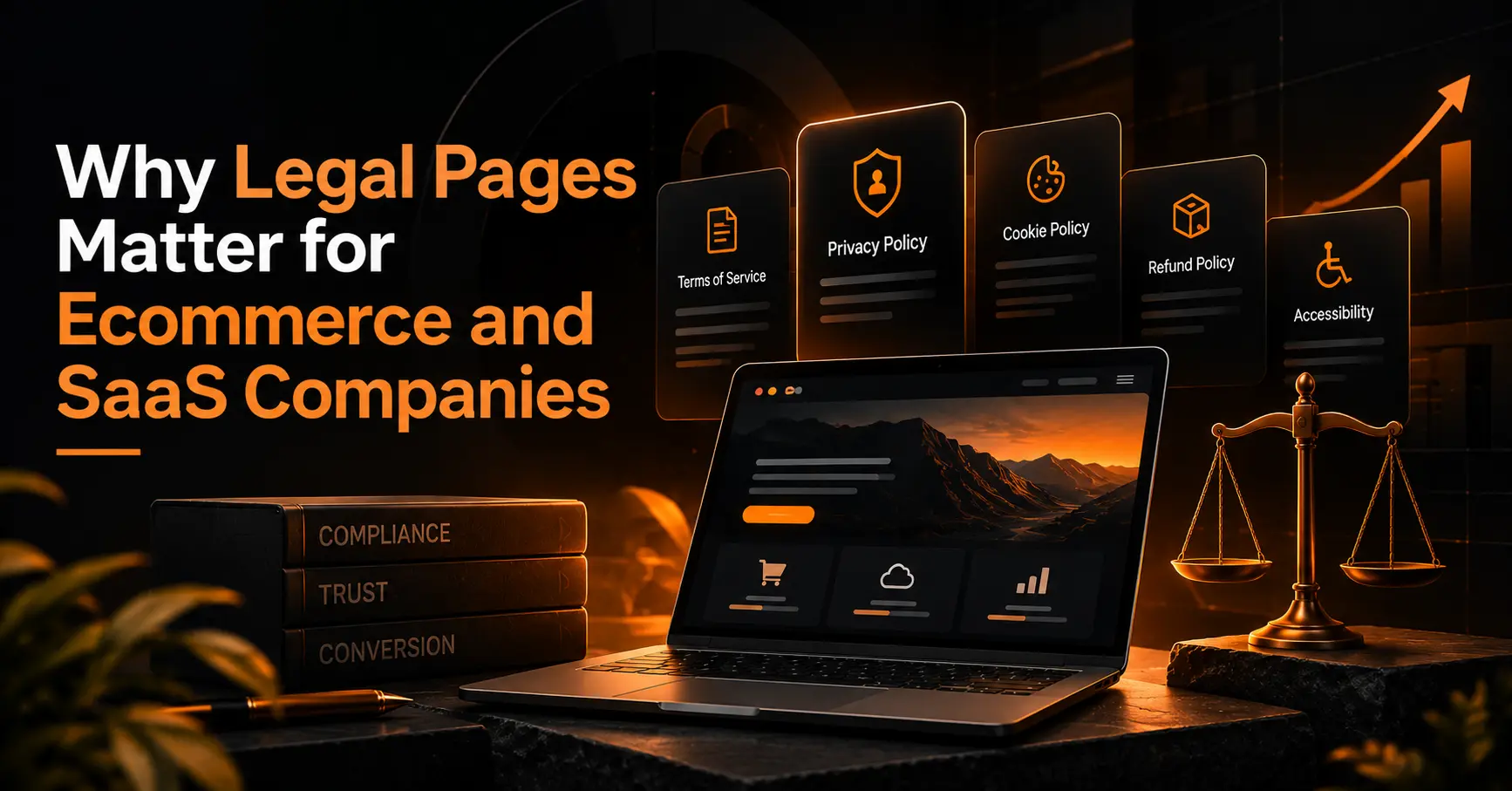
The Legal Pages Ecommerce and SaaS Sites Actually Need
| Page | Who needs it | What it covers |
|---|---|---|
| Privacy Policy | Every site | What data you collect, how you use it, who you share it with |
| Terms of Service | Every site | The rules of using your product, liability limits, account terms |
| Cookie Policy | Every site using analytics, ads, or trackers | What cookies you set and why, by category |
| Refund and Return Policy | Ecommerce | How refunds, returns, and exchanges actually work |
| Accessibility Statement | Every site, especially ecommerce | Your WCAG conformance target and how users can report barriers |
| DMCA / Copyright Notice | Sites with user-generated content, reviews, or uploads | How copyright takedown requests are handled, required for DMCA safe harbor |
| Acceptable Use Policy | SaaS | What users are not allowed to do with your platform |
| Data Processing Agreement | SaaS handling EU or enterprise customer data | How you process data on a customer's behalf, required before most enterprise deals close |
| Service Level Agreement | SaaS with paid or enterprise tiers | Uptime commitments, support response times, remedies if you miss them |
Privacy Policy vs Terms of Service: What's Actually the Difference
These two get confused constantly, and mixing them up is one of the fastest ways to end up with a page that does not actually cover what it needs to. A Privacy Policy is about data: what you collect from a visitor or customer, why you collect it, and who else sees it. It exists primarily to satisfy privacy law, and in most jurisdictions it is legally required the moment you collect any personal data at all, including just an email address on a contact form. Terms of Service is about conduct and contract: the rules of using your product, what you are and are not liable for, how accounts can be terminated, and what happens in a dispute. Nothing legally forces most businesses to have Terms of Service, but operating without one means you have no contractual protection at all if a user misuses your platform or disputes a charge.
Does Your Website Actually Need a Privacy Policy?
Yes, almost certainly, and the bar is lower than most business owners assume. If your site uses Google Analytics, runs any advertising pixel, has a contact form, processes payments, or sets any cookie beyond what is strictly necessary to load the page, you are collecting personal data and a Privacy Policy is required under GDPR if you have any EU visitors, CCPA if you have California visitors, and increasingly under a growing list of US state privacy laws with no minimum revenue threshold to trigger them. There is effectively no modern ecommerce or SaaS site that gets to skip this.
Legal Pages Are a Trust Signal, Not Just a Formality
Most advice treats legal pages as pure downside protection: have them so you cannot be sued. That misses half the picture. Checkout research consistently finds that unclear or hard to find return policies drive a meaningful share of cart abandonment, and that clear, visible return and refund policies measurably reduce it. The mechanism is simple. A shopper who cannot quickly find your return policy assumes the worst case and leaves rather than risk it. A visible, honestly written policy removes that hesitation at the exact moment it would otherwise cost you the sale.
The same logic applies to SaaS. An enterprise buyer's legal team will ask for your DPA before signing anything. If it does not exist, or it does not match how your product actually handles data, the deal stalls or dies in review, not because your product was wrong, but because a page was missing.
What a Refund Policy Actually Needs to Cover
A generic refund policy template rarely matches how a specific business actually operates, and that mismatch is where disputes come from. A refund policy that holds up needs to state the exact return window in days, whether that window starts at order date or delivery date, which product conditions qualify, who pays return shipping, whether the refund goes back to the original payment method or store credit, and how long the actual refund takes to process once a return is received. Vague language like "reasonable timeframe" or "case by case basis" reads as evasive to a customer and provides no real protection to you either, since it sets no defined standard to point back to when a dispute happens.
Accessibility and ADA Compliance: The Legal Page Almost Nobody Mentions
This is one of the fastest-growing legal risks for ecommerce specifically, and it is almost entirely absent from generic legal-pages content. Plaintiffs filed over 3,100 website accessibility lawsuits in US federal court in 2025 alone, a 27% increase over the previous year, and ecommerce sites are consistently the single most targeted category, with Shopify stores facing a disproportionate share of filings. An accessibility statement, paired with an actual WCAG 2.1 AA conformance effort rather than a widget bolted on afterward, is quickly becoming as standard as a privacy policy. Accessibility overlay widgets in particular have drawn specific regulatory criticism and even a fine against one provider for deceptive compliance claims, so a widget alone is not the fix it is often sold as.
The FTC's Crackdown on Subscription Dark Patterns
If your ecommerce store or SaaS product runs any kind of subscription or auto-renewal, this is the single most consequential regulatory shift in this space right now, and it barely appears in existing legal-pages content because it is new. The FTC has been actively enforcing against "dark patterns," interface and cancellation designs that trick or trap users into subscriptions they did not clearly agree to. The requirements are specific: clear and conspicuous disclosure of price, billing frequency, and cancellation terms before charging anyone, consent to a subscription obtained separately from other terms rather than buried in them, and a cancellation process that is genuinely as easy as sign-up, not a maze of phone calls or hidden menus. The scale of enforcement is real. Maximum civil penalties reach into the tens of thousands of dollars per violation, and violations are often counted per affected customer or per transaction, which is how penalties compound into the millions quickly. In one of the largest actions to date, a major online retailer agreed to a $1 billion civil penalty plus $1.5 billion in consumer refunds over deceptive subscription enrollment practices. If your Terms of Service and your actual cancellation flow do not match, that gap is exactly what this enforcement wave is built to find.
Where Most Sites Get the Setup Wrong
The words are rarely the problem. The implementation usually is.
- Buried in the footer only. A return policy that only exists as a tiny footer link gets found by almost nobody at the moment they are deciding whether to trust you. Linking it near the checkout CTA, not just the footer, is what actually reduces hesitation.
- Generic templates with placeholder text left in. A privacy policy that still references a product or data practice you do not actually have is worse than having none, since it signals nobody is paying attention.
- No last updated date. Regulators and reasonably savvy customers both treat an undated policy as a red flag.
- Inconsistent claims across pages. If your refund policy, your terms, and your checkout page describe your return window differently, that inconsistency itself is a liability, independent of what any single page says.
- Terms that don't match the actual cancellation flow. Writing "cancel anytime" while the real flow requires a phone call is exactly the mismatch current FTC enforcement is built to catch.
Your Cookie Banner Is Probably Not Doing What You Think
This is the part almost nobody writing about legal pages actually understands, because it is a build problem, not a writing problem. GDPR requires that non-essential cookies, analytics, ad pixels, tracking scripts, do not fire until a visitor has actually consented. Most cookie banners fail this in a very specific and very common way.
Here is the sequence most sites actually run: the page loads, the analytics and ad scripts fire immediately because they sit in the document head, the banner appears a moment later, and the user's eventual click on Accept has already happened after the tracking it was supposed to gate. A banner that displays correctly while scripts run freely underneath looks compliant and is not.
The correct sequence blocks those scripts from loading at all until consent is actually given, then activates them only for the categories the visitor approved. Getting this right generally means using a consent tool that intercepts and blocks scripts by default, wiring it into Google Consent Mode v2 if you run Google Ads or Analytics, and testing that tracking pixels genuinely do not fire pre-consent rather than assuming a banner plugin handles it. This is a configuration and code problem, which is exactly why it sits outside what a legal template can fix and squarely inside what a development team needs to own.
GDPR and CCPA: The Checklist Version
Both regulations get their own dedicated guides elsewhere, but here is what actually matters at the website level for an ecommerce or SaaS business.
- Lawful basis for data collection stated clearly, not just implied
- Cookie consent that actually blocks tracking pre-consent, covered above
- A working data request process , so a user asking what data you hold or asking for deletion has somewhere real to go, not a dead email address
- A "Do Not Sell or Share My Personal Information" link for CCPA if you sell to California residents and share data with third parties for advertising
- A list of subprocessors for SaaS companies, since enterprise customers increasingly expect this documented, not just promised
The financial stakes on both sides are real and specific. GDPR violations can reach up to €20 million or 4% of global annual revenue, whichever is higher. CCPA penalties run up to $7,500 per intentional violation, and violations are typically counted per affected consumer, which scales fast on any site with real traffic.
The Real Cost of Getting This Wrong
| Issue | Realistic exposure |
|---|---|
| GDPR violation | Up to €20 million or 4% of global annual revenue |
| CCPA violation | Up to $7,500 per intentional violation, counted per consumer affected |
| FTC dark pattern / subscription violation | Tens of thousands of dollars per violation, often counted per transaction |
| ADA website accessibility lawsuit | Typical small to mid-size settlement between $5,000 and $50,000, plus remediation costs |
| Lost sales from an unclear or hidden refund policy | A meaningful, measurable share of cart abandonment on every single day the policy stays unclear |
Should Legal Pages Be Indexed by Google?
A detail almost no legal guide mentions. Thin, boilerplate legal pages carry little unique content and are not something anyone is searching for by name. Letting Google fully index them adds low-value pages to your crawlable footprint without adding anything for site quality. The common technical SEO practice is to set these pages to noindex, follow, so they remain fully accessible to visitors and still pass link authority through your site, without competing for crawl budget or diluting the average quality signal of your indexed pages. It is a small setting most sites never touch, and it is a genuinely useful one.
SaaS: What Enterprise Buyers Actually Ask For
Self-serve customers accept your standard Terms of Service and move on. Enterprise customers do not. Once a deal crosses a meaningful contract value, their legal team will ask for a Data Processing Agreement, a defined Service Level Agreement with real uptime numbers and remedies, and sometimes a negotiated Master Service Agreement instead of your public terms. None of this needs to exist on day one of a SaaS product. It needs to exist before the first enterprise deal reaches the contract stage, because rebuilding this under deal pressure costs you leverage, and sometimes the deal itself.
How We Build This Into Every Site We Ship
We treat legal pages as part of the build, not an afterthought bolted on before launch. That means placing policy links where they actually reduce hesitation, not just where a template expects them, wiring cookie consent so it genuinely blocks tracking pre-consent instead of just displaying a banner, setting the right indexing rules so these pages help rather than dilute your SEO, and making sure your cancellation flow actually matches what your terms promise. On Hamarakhet , an AI-powered platform running live farmer auctions and data-driven diagnosis, getting consent, data handling, and participation terms right was not optional, it was part of making the platform usable at all. The same care applies to every ecommerce and SaaS build we take on.
FAQs
Do small ecommerce stores really need all of these pages?
At minimum, a Privacy Policy, Terms of Service, and a Refund and Return Policy. Cookie Policy becomes necessary the moment you run analytics or ad pixels, which almost every store does, and an Accessibility Statement is increasingly worth having given how heavily ecommerce is targeted by accessibility lawsuits.
Can I just use a free generator?
A generator can produce a reasonable starting draft. It cannot place the page correctly in your checkout flow, configure your cookie banner to actually block scripts, set the right indexing rules, or catch a mismatch between your stated cancellation policy and your actual cancellation flow, which is exactly where FTC enforcement is currently focused.
Does a cookie banner alone make me GDPR compliant?
No. A banner that displays while tracking scripts already run underneath it is not compliant, regardless of what the banner says. Compliance depends on scripts being blocked until consent is given, not on the banner's existence.
When does a SaaS company need a DPA?
Before it is asked for, which in practice means before pursuing any enterprise customer or anyone processing EU user data. Waiting until a deal requests one puts you negotiating from a weaker position.
Is an accessibility overlay widget enough to avoid an ADA lawsuit?
Generally no. Widgets have drawn specific regulatory criticism for creating an appearance of compliance without fixing underlying accessibility barriers, and lawsuits continue to target sites using them.
Get Your Legal Pages Built In, Not Bolted On
If your site's legal pages are a generic template sitting in the footer, your cookie banner has never actually been tested for whether it blocks tracking, or your cancellation flow does not quite match what your terms promise, that is worth checking before it costs you a sale, a deal, or a lawsuit. Get a free website audit or get in touch and we will look at what your site is actually doing versus what it should be doing.
Want a website that actually ranks & converts?
Book a free 30-minute strategy call. No pitch — just a clear plan for your traffic, design, and conversions.
More in TECH
Next.js SEO for AI Search: How to Get Your Site Seen in ChatGPT and Google AI Mode
ChatGPT, Claude and Perplexity read your raw HTML and skip your JavaScript. Learn how to make a Next.js site visible in AI search, from the Cache Components trap and htmlLimitedBots bugs to robots.ts, Content Signals, firewall checks, JSON-LD and crawler tests that prove it works.
High-Performance Animations and Technical SEO That Lift Conversion Rates
Most agencies sell you animation, then quietly cost you conversions with it. Here is what the data says about speed and revenue, why UI motion is usually the thing breaking Core Web Vitals, and the exact rules we use to ship cinematic sites that still pass.