Does My Business Need a Website? Here's the Honest Answer
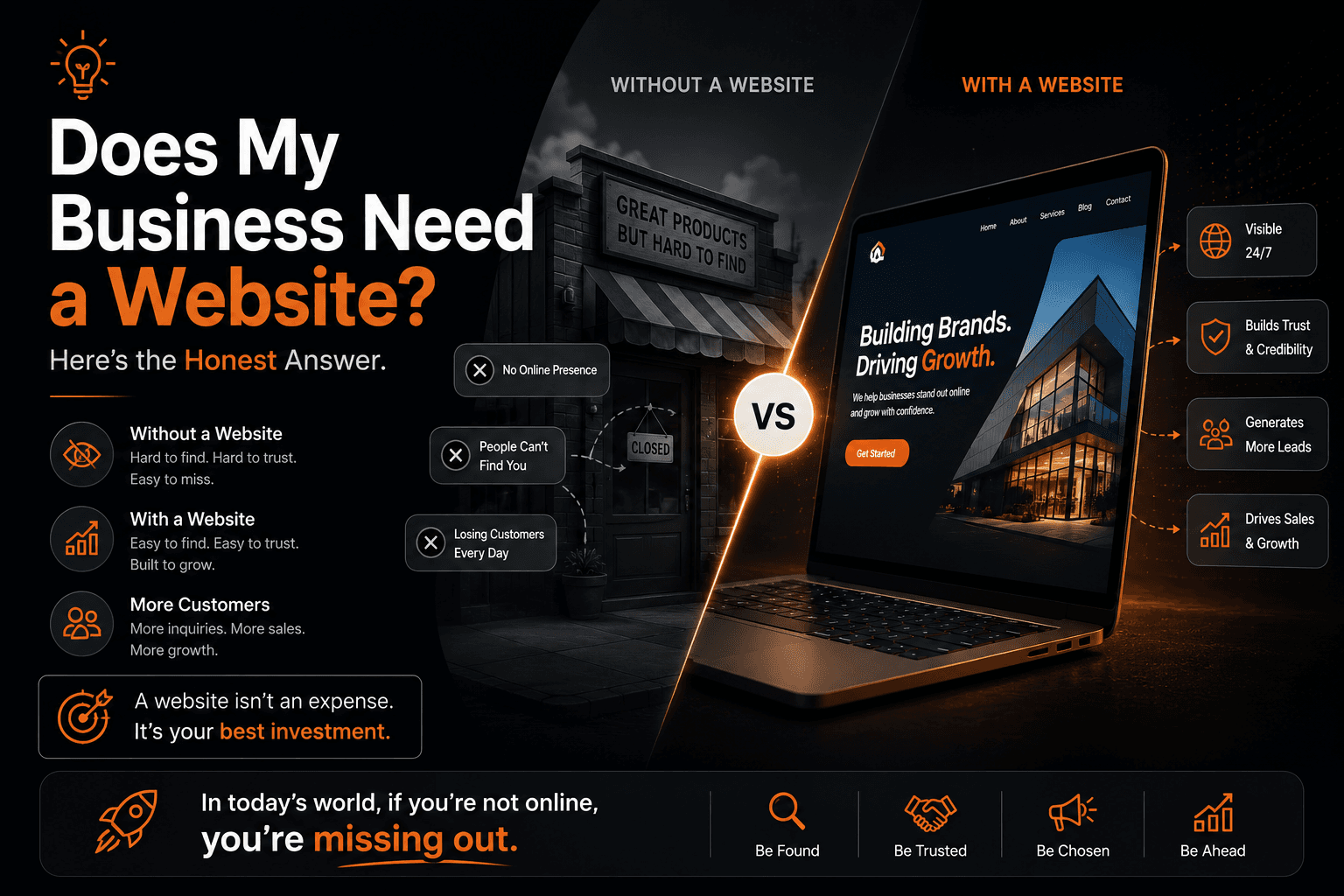
You have built something real. A product, a service, a skill that people genuinely need. But when a potential customer types your business name into Google, nothing shows up. Or worse, they find your Instagram with a few posts from six months ago. That is the moment you lose them, not to a better business, but to a more visible one.
In 2026, a website is not a nice-to-have. It is the foundation of how customers find, evaluate, and trust your business before they ever speak to you. This guide answers the questions small business owners ask most: does my business actually need a website, how much will it cost, and which platform makes the most sense for where you are right now.
Why a Website Is Non-Negotiable in 2026
According to research cited by Wix and confirmed across multiple industry sources, 81% of shoppers conduct online research before making a purchase . That figure holds whether the purchase happens online or in a physical store. People are Googling your business, reading about what you offer, and forming an opinion before they ever pick up the phone.
A joint Google and Deloitte research study of over 4,500 small businesses found that businesses using digital tools, including websites, were 2.8x more likely to grow revenues compared to those without an online presence. That is not a marginal difference. That is the gap between a business that scales and one that stalls.
What Happens Without a Website
The cost of not having a website is silent and ongoing. Most business owners never see what they are losing because the customers who could not find them simply went elsewhere. Here is what that looks like in practice:
- A referred customer searches your business name to verify you are real. They find nothing and move on.
- A local customer searches for your service on Google. You do not appear. A business that does appear gets the call.
- An AI assistant or voice search is asked about businesses like yours in your area. With no website, you have no content for it to cite.
- A potential client wants to see your past work before reaching out. There is nowhere to send them.
According to data from B2B Lead Finder , a local business without a website loses an estimated 20 to 35% of referred customers during the verification step alone. Those are warm leads, people who were already told about you, who still did not convert because they could not confirm you were credible.
Social Media Is Not a Replacement
This comes up often. If a business is active on Instagram or Facebook, does it still need a website? The answer is yes, and the distinction is important.
- You do not own your social media presence. Platforms change their algorithms, reduce organic reach, and can suspend or delete accounts. Your website is the only digital property you own outright.
- Social platforms do not rank in Google the same way. A properly optimized website page can bring you consistent organic traffic from search for years. A social post lasts a few hours in a feed.
- Trust is built differently. Research consistently shows that 75% of users judge a business's credibility based on its website design, according to data cited by Wix's small business statistics report . A profile page does not carry the same weight.
- Small businesses with both a website and social media presence generate 2x more revenue than those relying on social media alone, per industry benchmarks.
Social media works best as a traffic channel that drives people to your website, not as a substitute for one.
Does a Small Business Need a Website?
Yes, and small businesses often benefit from a website more than large corporations do. Here is why that matters.
A Website Levels the Playing Field
A well-built, SEO-optimized website lets a solo consultant or a two-person local business appear just as credible and professional as a company with hundreds of employees. Design quality and page performance communicate authority. A fast, clean, purpose-built website signals that you take your business seriously, even if you are just starting out.
Local Search Converts at a High Rate
According to data from Zippia , at least 78% of location-based mobile searches result in an offline purchase. When someone searches for a service near them and finds your website in the results, they are already close to buying. A website with proper local SEO is one of the most effective lead generation tools a small business can have.
Your Website Works Around the Clock
A physical shop or office has hours. Your website does not. A potential client can read your services at midnight, browse your portfolio at 6 AM, and submit an inquiry before you are even awake. That kind of availability is impossible to replicate through any other channel.
Key Reasons Every Business Needs a Website
1. Credibility and First Impressions
Research shows that 94% of first impressions of a business are tied to its website design . Users form an opinion about your website in approximately 50 milliseconds, and that opinion determines whether they stay or leave. A business with no website, or with a poorly built one, immediately loses credibility with anyone who looks it up.
A professional website tells your story. It shows your work, your process, your team, and your values in a way that a social profile cannot. It answers questions before they are asked and reduces the friction between a visitor arriving and a lead being generated.
2. Organic Search Traffic That Compounds Over Time
Search Engine Optimization is the only marketing channel that gets more effective over time without increasing in cost. A blog post, a service page, or an FAQ section you publish today can rank on Google and bring you qualified visitors for years. Paid ads stop the moment you stop spending. SEO keeps working.
Google Search Console is a free tool that shows you exactly which queries bring people to your website and how your pages perform in search results. Without a website, you have no access to this data and no presence in organic search at all.
3. Lead Generation on Autopilot
Contact forms, inquiry buttons, portfolio galleries, and booking integrations all sit on your website and collect leads while you focus on doing the actual work. A well-designed website qualifies and captures potential customers automatically, 24 hours a day, without you needing to be actively present.
4. A Central Hub for All Your Marketing
Every marketing channel performs better when it has a destination. Whether you are running Google Ads, sending email campaigns, or posting on social media, all of that activity should direct people to a website that converts. Without a website, your marketing efforts scatter and lose effectiveness.
How a Website Supports Each Marketing Channel
| Marketing Channel | Without a Website | With a Website |
|---|---|---|
| Google Ads | No landing page to convert traffic | Purpose-built pages that convert clicks to leads |
| Instagram / Facebook | Dead-end social profile | Drives traffic to portfolio, services, or booking |
| Email Marketing | Nowhere to send readers | Campaign-specific landing pages with clear CTAs |
| Word of Mouth | Prospect cannot verify you | Prospect validates credibility and converts |
| AI and Voice Search | Business is invisible to AI tools | Content gets cited and recommended |
5. Analytics and Business Intelligence
Your website generates data no other channel can match. Free tools like Google Analytics show you how visitors find you, which pages they spend time on, where they drop off, and what actions they take. This information shapes better decisions across your entire business, not just your marketing.
6. Ownership and Control
Social platforms change their rules. Algorithms shift. Accounts get flagged or suspended. Your website belongs to you entirely. No platform can take it away, limit your reach, or charge you to show it to your own audience. In the long run, the businesses that build on owned digital assets are the ones with the most stable and predictable growth.
Can I Build a Website Under 10k to 15k?
Yes, you can. And here is an honest breakdown of what different price points actually get you in 2026.
What a Budget of 10k to 15k Gets You
At this price range in India, a professionally built website is genuinely achievable. This is the range where I work for small brands that are just starting to build their digital presence. What you get at this budget:
- A fully custom-designed website, not a template with your logo swapped in
- 4 to 6 pages covering home, about, services, portfolio, and contact
- Full mobile and device responsiveness
- Basic on-page SEO setup including metadata, structured data, and sitemap
- Performance optimization for fast load times
- Clean, maintainable code that you own completely
My minimum engagement starts at ₹15,000 , which covers development only. Domain and hosting are separate, and the costs for those depend on the platform you choose, which I cover in the next section.
Domain and Hosting: What You Actually Need to Budget
| Item | Approximate Annual Cost | Notes |
|---|---|---|
| Domain Name (.com) | ₹800 to ₹1,500 | Purchased via registrars like GoDaddy or Namecheap |
| Shared Hosting (WordPress) | ₹2,500 to ₹8,000/year | Providers like Hostinger offer reliable plans at this range |
| Next.js on Vercel (Free Tier) | ₹0 | Only domain cost applies. Best for small brands. See below. |
| SSL Certificate | ₹0 in most cases | Free with Hostinger hosting and Vercel deployments |
Which Platform Should My Business Website Use?
This is where most business owners feel overwhelmed, and rightly so. There are dozens of platforms and every agency promotes the one they prefer. My recommendation is based purely on what genuinely fits the size and goals of your brand.
Next.js: The Smartest Choice for Small and Growing Brands
For most small businesses and new brands that are focused on building their identity and online presence, I recommend building with Next.js deployed on Vercel . The reason is straightforward: with Vercel's free hosting tier, you pay only for your domain name. That is your only recurring cost after development.
Next.js also delivers exceptional performance out of the box. Built-in image optimization, font optimization, server-side rendering, and automatic code splitting all contribute to strong Core Web Vitals scores, which directly affect how Google ranks your website. Case studies show Next.js implementations achieving 25% to 40% improvements in page load performance after migration.
Why Next.js Is the Right Call for a Small Brand
- Near-zero running cost. Vercel's free tier comfortably handles small business traffic levels under 50,000 monthly visitors with no charge beyond the domain.
- SEO advantages built in. Server-side rendering and static generation ensure search engines index your content accurately and completely.
- Performance by default. Automatic image compression, font loading optimization, and code splitting are standard, not extras you configure later.
- No maintenance overhead. No plugin updates, no server patches, no database vulnerabilities. The site simply runs.
- Scalable from day one. The same codebase that serves a five-page portfolio site can handle thousands of pages and complex functionality as your business grows.
WordPress: For Content-Heavy Sites and E-Commerce
WordPress powers roughly 43% of all websites globally according to W3Techs . It is the right choice for businesses with frequent content publishing needs, large teams managing the site without developer help, or anyone building a WooCommerce store. Hosting through providers like Hostinger keeps costs manageable.
The tradeoff is real maintenance overhead. Plugins need updating, security patches need applying, and hosting costs are ongoing. For a small brand just starting out, this is unnecessary complexity.
Webflow: For Design-First Brands
Webflow is an excellent option for businesses that need a visually distinctive, designer-quality website and do not have a dedicated developer. It produces clean, well-structured output with good SEO support. The main consideration is a monthly subscription fee that increases as your site grows.
Wix: For the Simplest DIY Presence
Wix allows anyone to build a basic website quickly using drag-and-drop tools with no technical knowledge required. It is a reasonable option for a very basic digital footprint, but its SEO capabilities and performance ceilings are limited compared to Next.js or even WordPress. It works for a hobby project or an extremely early-stage venture where budget is the primary constraint.
Platform Comparison
| Platform | Best For | Hosting Cost | SEO Capability | Performance |
|---|---|---|---|---|
| Next.js | Small brands, startups, performance-focused builds | ₹0 (Vercel free tier) | Excellent | Best in class |
| WordPress | Content-heavy sites, WooCommerce stores | ₹2,500 to ₹8,000/year | Good (with plugins) | Good |
| Webflow | Design-focused brands, agencies | $14 to $39/month | Good | Good |
| Wix | DIY basic presence, hobby projects | $10 to $17/month | Limited | Average |
What SEO Is Included With Your Website
Every website I build includes a foundational SEO setup as part of the build process, not as an optional add-on. A beautifully designed website that search engines cannot read properly is a missed opportunity from day one.
What Basic SEO Covers
- Optimized meta titles and meta descriptions for every page
- Canonical tags to prevent duplicate content issues
- Structured data markup (Schema.org) for your business type, services, and content
- XML sitemap generation and submission to Google Search Console
- robots.txt configuration for proper crawl control
- Heading hierarchy structured correctly from H1 through H3
- Alt text for all images to support both accessibility and image search
- Core Web Vitals optimization for speed, interactivity, and layout stability
SEO Is a Long-Term Investment
Basic SEO gets your website indexed correctly and structured for search engines to understand. Ranking for competitive keywords takes time, consistent content publishing, and quality backlinks. But the businesses that start building this foundation now are the ones that dominate search results in 12 to 24 months. Every month without a website is a month of SEO authority you cannot recover.
Real Talk: Why Now Is the Right Time
In India, approximately 50 to 55% of small businesses still operate without a website, according to data from B2B Lead Finder . That means if your business gets a professional, well-optimized website today, you are immediately ahead of more than half of your local market online. That gap will not exist forever. The businesses investing in their web presence now are building a lead that will compound year after year.
"In 2026, not having a website is like not having a phone number in 1990. It does not mean you are not in business. It means customers cannot find you."
A website is not an expense. It is an asset that works for your business around the clock, generates leads while you sleep, builds your brand authority over time, and creates a foundation that every other marketing channel can build on top of.
Ready to build a website that actually brings in clients?
Custom websites starting at ₹15,000. Next.js builds with free hosting. Basic SEO included. Domain only extra.
Let's Talk About Your WebsiteWant to see what this looks like in practice before you reach out? Browse the projects I have built across hospitality, agritech, e-commerce, and SaaS. Every project is built on the same principles: fast performance, clean SEO architecture, and brand clarity that converts.
Want a website that actually ranks & converts?
Book a free 30-minute strategy call. No pitch — just a clear plan for your traffic, design, and conversions.
More in TECH
High-Performance Animations and Technical SEO That Lift Conversion Rates
Most agencies sell you animation, then quietly cost you conversions with it. Here is what the data says about speed and revenue, why UI motion is usually the thing breaking Core Web Vitals, and the exact rules we use to ship cinematic sites that still pass.
Website Developer in Kolkata: Modern Sites Built to Convert
Search "website developer in Kolkata" and you will mostly find WordPress-template agencies competing on who can call themselves the best the most times. Here is what a modern build actually looks like, with real projects you can click through.