Supabase vs Firebase: The Right Backend for Your Project
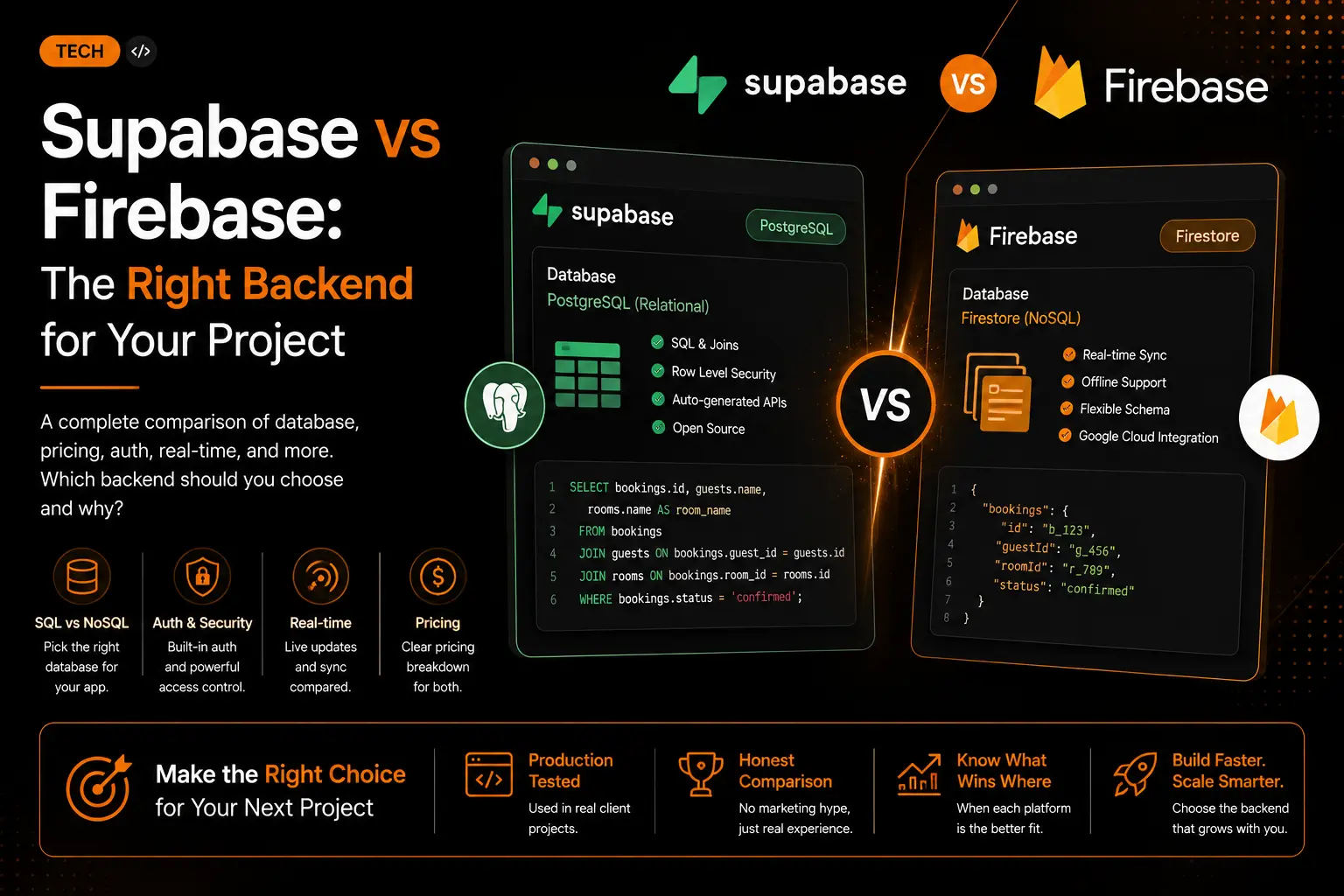
Every developer building a SaaS, a booking platform, or a mobile app eventually hits the same fork in the road: Supabase or Firebase? We have shipped production work on both, including a live boutique hotel booking platform and an AI powered agri-tech platform, and this comparison is built from that experience, not a feature list copied from a marketing page.
Short answer: we chose Supabase for almost everything we build now. Here is the full reasoning, real pricing numbers, and the cases where Firebase is still the smarter pick.
What Is Firebase?
Firebase is Google's backend as a service platform, built around Firestore, a NoSQL document database. Data lives in flexible, schema-less collections, which makes it fast to start and genuinely excellent for anything that needs live, real-time sync out of the box, think chat apps, multiplayer games, and collaborative tools. Firebase also ships mature mobile SDKs, tight Google Cloud integration, offline data persistence, and push notifications through Firebase Cloud Messaging, none of which Supabase currently matches.
What Is Supabase?
Supabase describes itself as the open source Firebase alternative, though that undersells it. It wraps PostgreSQL, the world's most established relational database, with auto-generated REST and GraphQL APIs, authentication, file storage, real-time subscriptions, and serverless Edge Functions. Because the core is plain Postgres, you get SQL, joins, foreign keys, and Row Level Security policies, and you can self-host or migrate the entire stack whenever you want. Supabase has grown into one of the most widely adopted open-source backend projects, with well over a million registered developers and tens of thousands of stars on GitHub, and it now powers backends for companies including Mozilla and PWC.
Supabase vs Firebase: Quick Comparison
| Category | Firebase | Supabase |
|---|---|---|
| Database | Firestore, NoSQL document store | PostgreSQL, relational |
| Query language | Document reads, no joins | Full SQL with joins, CTEs, views |
| Authentication | Mature, broad OAuth support | Built in, integrates with Row Level Security |
| Real-time sync | Native from day one, strong offline support | Available via Postgres changes, offline support is basic |
| Pricing model | Per read, write, and delete | Compute and storage based |
| Open source | No | Yes, self-hostable |
| Vendor lock-in | High, proprietary format | Low, standard Postgres |
| Mobile push notifications | Built in, Firebase Cloud Messaging | Not native, requires a third-party service |
| Best for | Mobile-first, real-time, offline-first apps | Relational, SQL-heavy, AI-driven apps |
The Database Question: SQL vs NoSQL
This is the decision that actually shapes everything else. Firestore stores documents, so your data can be nested and shaped however you like, which is liberating early on but painful once your app has real relationships. Booking data, room inventory, orders, and users are relational by nature, and stitching them together with multiple document reads in application code gets messy fast.
Supabase stores rows in Postgres tables, so a simple relationship like a guest booking a room looks like this:
SELECT bookings.id, guests.name, rooms.name AS room_name FROM bookings JOIN guests ON bookings.guest_id = guests.id JOIN rooms ON bookings.room_id = rooms.id WHERE bookings.status = 'confirmed'; One query, no client-side stitching. For anything with users, orders, or inventory, this alone is often reason enough to pick Supabase.
Authentication and Row Level Security
Both platforms handle email, OAuth, and magic link authentication well. The real difference is where authorization logic lives. Firebase Security Rules use their own proprietary rules language, written and tested separately from your actual data model. Supabase ties auth directly into Postgres Row Level Security, so access rules are enforced by the database itself, in the same SQL you already use for everything else.
CREATE POLICY "Guests can view their own bookings" ON bookings FOR SELECT USING (auth.uid() = guest_id); Once a policy like this exists, no query, no API route, no third-party integration can leak another guest's booking data. That is a meaningfully different, and more auditable, security model than checking permissions in application code every time.
Pricing: What You Actually Pay
Firebase charges per document read, write, and delete, which sounds fine until a single unoptimized query pulls thousands of documents to display ten results. Supabase charges primarily for compute and storage, which is far easier to predict. As a rough, commonly reported benchmark, a SaaS product with around 50,000 active users typically lands somewhere in the low hundreds of dollars per month on Supabase, while a comparable read-heavy Firestore setup can run two to four times higher once you account for operation volume. Always check each platform's current pricing calculator for your exact numbers, but the underlying pattern holds regardless of when you read this: Firestore bills scale with usage patterns that are hard to forecast, Postgres bills scale with data size and compute that you can actually plan around.
| Scale | Firebase (Firestore, Blaze plan) | Supabase (Pro plan) |
|---|---|---|
| Free tier | 50K reads, 20K writes, 20K deletes per day, 1GB storage | 500MB database, unlimited API requests, 50K monthly active users for auth |
| Small app | Free until usage caps are hit, then pay-per-operation | Flat monthly base, then usage-based add-ons |
| Growth stage | Costs can spike sharply with read-heavy features | Scales more linearly with database size and compute |
Firebase is not more expensive by default, it is less predictable. A viral spike or a badly written query can double a Firestore bill overnight. If you are researching supabase pricing or asking which is cheaper firebase or supabase, the honest answer is that Supabase tends to win on predictability first, and often on total cost once you scale past a hobby project.
Built for the Way AI Coding Tools Work
This is a newer consideration, but it matters more every year. AI coding assistants and agent-based tools work with a database primarily by reading its schema. A Postgres schema with named tables, columns, and foreign key relationships gives an AI assistant a clear, structured map of your data, so generated queries and migrations tend to be accurate. Firestore's schema-less documents give an AI assistant far less to reason about, since the same collection can hold documents with different shapes. If your workflow leans on AI-assisted development, and most modern workflows increasingly do, Supabase's relational structure is simply easier for tooling to understand correctly.
Automation: Supabase with n8n
If your stack includes workflow automation, this matters more than most comparisons mention. Supabase being plain Postgres means it drops straight into n8n, Zapier, or any tool that speaks SQL or REST, with no proprietary SDK required. We use this pattern to run automated content and data pipelines that read and write directly to Supabase tables. Firestore's document format needs extra transformation steps to work the same way, which adds friction to every automation you build.
Vendor Lock-in, Self-Hosting, and Compliance
Firebase is a Google-only product. If you ever decide to leave, you are rewriting your entire data layer, because Firestore has no open-source equivalent. Supabase is a wrapper around standard PostgreSQL, so your data, schema, and auth users can be exported with pg_dump and moved to AWS, DigitalOcean, or your own server at any time. This also matters for compliance. If a client ever needs strict data residency, an air-gapped environment, or full control over where data physically lives, self-hosting Supabase is possible. Firebase offers no equivalent path, because there is nothing to self-host. For an agency building long-term client platforms, client-owned, portable data is part of what we promise, and Firestore cannot make that promise the same way.
Real Project: Why We Chose Supabase
Two live examples from our own work show this in practice.
- Ghar Bar Boutique Stay & Cafe , a boutique hotel in Dharamshala, needed rooms, galleries, and live booking data that had to stay accurate and relational. Supabase powers the rooms and gallery data with Row Level Security controlling what is public versus admin-only.
- Hamarakhet , an AI-powered agri-tech platform for Indian farmers, runs live auctions, crop disease diagnosis, and weather data on a near-zero-cost serverless stack built on Supabase, Postgres, and Row Level Security, with AI inference layered directly on top of the same database.
In both cases, the relational data model and predictable pricing made Supabase the only sensible choice. Firebase's real-time sync, its strongest feature, was not something either project actually needed.
When Firebase Still Makes Sense
This is not a one-sided pitch. Firebase genuinely wins in a few scenarios.
- Mobile-first apps that lean heavily on Firebase's mature iOS and Android SDKs, offline persistence, and Firebase Cloud Messaging for push notifications
- Chat, multiplayer, or live-collaboration apps where real-time sync is the core feature, not an add-on
- Fast prototypes and hackathon projects where document flexibility beats schema design speed
- Teams already deep inside Google Cloud, where Firebase integrates natively with BigQuery and Analytics
If none of the above describes your project, and your data has any real relationships between users, orders, bookings, or content, Supabase is very likely the better long-term foundation.
Supabase vs Firebase: Which Should You Choose?
| Choose Supabase if | Choose Firebase if |
|---|---|
| Your data is relational (bookings, orders, users, inventory) | Real-time sync is the core feature, not a nice-to-have |
| You want predictable, usage-based pricing | You are building a mobile-first app that needs offline sync and push notifications |
| You care about data portability, self-hosting, or open source | You are already deep in the Google Cloud ecosystem |
| You are building AI features with vector search or use AI coding tools | You need the fastest possible prototype, schema optional |
FAQs
Is Supabase the best database for a new project?
For most SaaS, booking, e-commerce, and content-driven apps, yes. Supabase gives you full Postgres under the hood, which handles relational data, complex queries, and future growth better than a NoSQL document store.
Is Supabase actually a Firebase alternative or something different?
Supabase is often called an open source Firebase alternative, and it covers the same categories, auth, database, storage, real-time, functions, but the underlying architecture is fundamentally different. Firebase is document-based and proprietary. Supabase is relational and open source.
Which is cheaper, Firebase or Supabase?
It depends on your usage pattern, but Supabase's flat, storage-based pricing is far easier to predict than Firestore's per-operation billing, where a single inefficient query can spike your bill unexpectedly.
Can I migrate from Firebase to Supabase later?
Yes, though it involves remodeling your data from documents into relational tables. It is more work than switching hosting providers, which is exactly why choosing the right one from the start matters.
Need Help Deciding for Your Project?
Choosing between Supabase and Firebase is only one piece of building a backend that actually holds up in production. If you are planning a Next.js build and want a second opinion on your data model, hosting, or SEO setup, get a free website audit or get in touch and we will walk through what fits your project best.
Want a website that actually ranks & converts?
Book a free 30-minute strategy call. No pitch — just a clear plan for your traffic, design, and conversions.
More in TECH
High-Performance Animations and Technical SEO That Lift Conversion Rates
Most agencies sell you animation, then quietly cost you conversions with it. Here is what the data says about speed and revenue, why UI motion is usually the thing breaking Core Web Vitals, and the exact rules we use to ship cinematic sites that still pass.
Website Developer in Kolkata: Modern Sites Built to Convert
Search "website developer in Kolkata" and you will mostly find WordPress-template agencies competing on who can call themselves the best the most times. Here is what a modern build actually looks like, with real projects you can click through.