Why Next.js Is the Best Framework for Businesses in 2026: From Startups to Enterprises
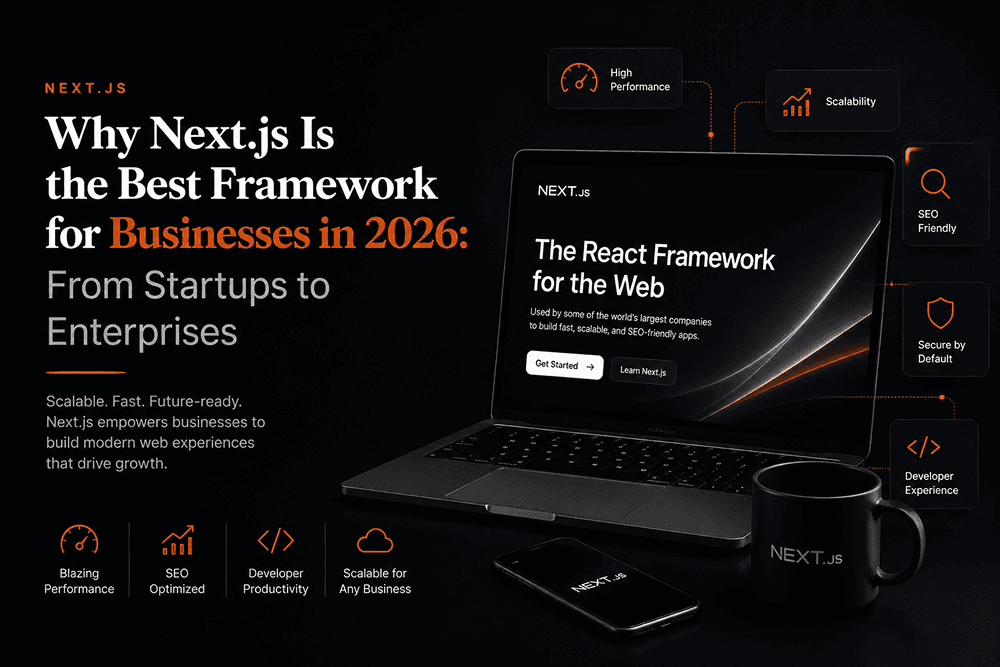
Every founder I meet asks the same question: "What framework should I build my website on?" In 2026, the honest answer is almost always the same: Next.js . It is the engine quietly powering Netflix, Nike, OpenAI, TikTok, and thousands of fast-growing startups. If you run a small business and want to grow, or a large company that needs to scale, Next.js is the most predictable path to a fast, SEO-friendly, future-proof website. Let me show you why, and what it would actually cost you to build one.
Key Takeaways
- 68% of JavaScript developers use Next.js, and 17,000+ verified companies (Netflix, Nike, OpenAI, IBM, Stripe) run production websites on it.
- 89% of Next.js teams hit Google Core Web Vitals on their very first deployment, which directly translates into better Google rankings.
- Next.js sites typically score 95 to 100 on PageSpeed Insights , while WordPress sites average 60 to 70.
- Hosting on Vercel is free for almost all small-to-medium business projects, removing a recurring expense.
- A poorly built website can cost an Indian SMB ₹40 lakh to ₹1.2 crore over 3 years in lost leads and rebuild expenses.
- Starter Next.js builds begin at ₹15,000 , scaling fairly into enterprise quotes.
What Is Next.js, in Plain English
Next.js is a React-based framework created by Vercel that solves the three problems every business website struggles with: speed, SEO, and scalability . Instead of stitching together a Frankenstein stack of plugins, themes, and patches (the WordPress route), Next.js gives you one clean foundation that renders pages on the server, ships only the JavaScript a page needs, and indexes beautifully on Google from day one.
In short, it is the same framework powering some of the most-visited websites on Earth, available to you at the same level of polish, whether you are a boutique hotel, a SaaS startup, or a global brand.
Why Next.js Is a Better Option for New Businesses
If you are just starting out, every rupee and every second matters. You cannot afford a slow website, hidden hosting bills, or a stack that becomes a liability in a year. Next.js gives new businesses an unfair advantage on day one.
- Free, world-class hosting via Vercel. Your site lives on a global CDN by default. No separate hosting bill, no cPanel headaches.
- Blazing-fast page loads. Static pages serve in milliseconds, which directly improves bounce rate and conversions.
- SEO baked in. Server-rendered HTML means Google can read every word, with no JavaScript blocking issues that plague client-only React apps.
- Image, font, and script optimization out of the box. You get a near-perfect Core Web Vitals score without hiring an extra performance engineer.
- Future-proof architecture. Start with a single landing page today, grow into a multi-region e-commerce platform later, all on the same codebase, no rebuild.
- Tiny attack surface. No WordPress plugins to patch every Monday morning.
A 2025 developer survey found that 89% of teams using Next.js met Google Core Web Vitals thresholds on their first deployment . For a new business, that is free SEO ranking power most competitors are still paying agencies to fix.
Why High-Level Enterprises Trust Next.js
Next.js is not just a "startup framework." It is what the world's biggest companies run their flagship properties on. Enterprises pick it because it solves problems that only become painful at scale: tens of thousands of pages, hundreds of contributors, global audiences, and uptime measured in nines.
Top Companies Using Next.js in 2026
| Company | Industry | What They Use Next.js For |
|---|---|---|
| Netflix | Streaming | Careers portal and marketing properties |
| TikTok | Social / Media | Public-facing web experience |
| Nike | E-commerce / Apparel | Storefront and brand sites |
| OpenAI | Artificial Intelligence | Product and marketing site |
| Stripe | Fintech / Payments | Documentation and marketing |
| Marriott | Hospitality | Booking and brand experience |
| IBM | Enterprise IT | Corporate website |
| McDonald's | F&B / Retail | Submissions and campaign portals |
| Twitch | Live Streaming | Web platform |
| Hulu | Streaming | Marketing and account experience |
According to a 2026 adoption report , 9.5% of Next.js users are enterprises with 10,000+ employees , and the sweet spot is companies with 11 to 200 employees (34.8% of all users). Translation: it is already the consensus choice across every business size. You would not be picking something experimental.
Next.js vs WordPress vs Wix vs Plain React
Most clients ask me to compare Next.js with WordPress, Wix, or a plain React app. Here is the honest, no-marketing-speak breakdown.
| Feature | Next.js | WordPress | Wix / Squarespace | Plain React (CRA) |
|---|---|---|---|---|
| SEO out of the box | Excellent | Plugin-dependent | Limited control | Needs heavy setup |
| PageSpeed score (avg) | 95 to 100 | 60 to 70 | 70 to 80 | Varies wildly |
| Hosting cost (annual) | Free on Vercel | ₹3,000 to ₹15,000 | ₹12,000+ | Varies |
| Security and updates | Auto / minimal | Constant plugin patching | Managed | Manual |
| Scales to enterprise | Yes (Netflix, Nike) | With heavy customization | No | Hard to grow |
| Custom design freedom | Unlimited | Theme-locked | Template-locked | Unlimited |
| Time to market | 1 to 5 weeks | 1 to 4 weeks | 1 to 7 days | 4 to 8 weeks |
Real 3-Year Cost of Ownership Comparison
The upfront price is rarely the true price. Here is what a typical small-business website actually costs over three years:
| Cost Item | Next.js (built right) | WordPress (typical SMB) |
|---|---|---|
| Initial build | ₹15,000 to ₹75,000 | ₹10,000 to ₹50,000 |
| Hosting (3 years) | ₹0 (Vercel free tier) | ₹9,000 to ₹45,000 |
| Premium plugins / themes | ₹0 | ₹15,000 to ₹40,000 |
| Security and maintenance | Minimal | ₹18,000 to ₹60,000 |
| Performance fixes / SEO patching | Built in | ₹20,000 to ₹50,000 |
| Approx. 3-year total | ₹15,000 to ₹75,000 | ₹72,000 to ₹2,45,000 |
SEO and Performance Benefits That Drive Real Revenue
A faster, better-indexed website is not a vanity metric. It is measurable revenue. Google Core Web Vitals are now an official ranking factor, and Google research shows that 53% of mobile users abandon a site that takes longer than three seconds to load . Next.js fixes that at the architecture level, not with a plugin.
What you get out of the box with a Next.js build:
- Server-Side Rendering (SSR) so pages arrive at the browser already rendered, letting Google index 100% of your content.
- Static Site Generation (SSG) for blog posts, landing pages, and product pages served from a global CDN in under a second.
- Incremental Static Regeneration (ISR) keeps content fresh without rebuilding the entire site.
- Metadata API for clean title tags, Open Graph, Twitter Cards, and JSON-LD structured data, all version-controlled in code.
- Automatic image and font optimization so no 4 MB hero images drag your mobile rank down.
- Edge functions and route-level caching keep your site fast even under traffic spikes.
- App Router architecture built on React 19, ready for the next decade of the web.
Real-world impact: Netflix reported improved organic search traffic and user acquisition after moving to Next.js. Airbnb saw significant gains in marketing performance and traffic after the same migration. The pattern repeats with smaller businesses too, usually within 60 to 90 days of launch.
How a Bad Developer Can Wreck Your Entire Business
This is the section most agencies will not write, but you need to read. The wrong developer does not just deliver a bad website. They actively bleed your business for years.
The compounding damage of cheap, careless development:
- Lost sales from slow load times. Google research shows that a 3-second delay can lose more than half your mobile visitors. On 500 monthly visitors, that is 250 people leaving before they read a single word.
- Invisible to Google. A poorly built site with no semantic HTML, broken metadata, missing alt tags, or render-blocking JavaScript will never rank, no matter how good your service is. 91% of clicks go to page 1. You are on page 4.
- Security disasters. Outdated WordPress installs and sloppy code get hacked. Industry research shows that fixing a bug in production costs 100 times more than catching it during design.
- Bounce rate and trust collapse. Stanford Web Credibility Project found that 75% of consumers judge a company's credibility by its website design . People decide in 50 milliseconds. A bad site costs you the lead before you even know they visited.
- Technical debt that strangles future growth. Hacky shortcuts now mean a full rebuild in 18 months. You will pay twice, once for the bad build, once to replace it.
- Reputation damage. 88% of users will not return after a bad experience , and 32% will never visit your brand again after a single bad first impression.
- Wasted ad spend. Every rupee you spend on Google or Meta ads funnels traffic to a slow, broken funnel that does not convert. A bad website is a leak in the bottom of the bucket.
Independent estimates put the 3-year cost of a badly built business website at ₹40 lakh to ₹1.2 crore in lost leads, paid-ad waste, and rebuild costs. That is the real price of going with the cheapest quote.
When Next.js Might NOT Be the Right Choice
Honesty matters more than marketing. There are a few cases where I will tell you Next.js is overkill or wrong for your goal:
- You need a one-page brochure with no growth plans. A simple HTML page or Webflow site will do, and I can build that for you in either tech.
- You depend on a very specific WordPress plugin (certain LMS, membership, or community plugins) that has no equivalent in the JavaScript ecosystem.
- You will manage everything yourself with zero developer involvement, ever. A managed builder like Wix or Squarespace may suit you better, though you trade away SEO control and scale.
- You publish content multiple times a day and have no editor on the team comfortable with a headless CMS. In that case, headless WordPress + Next.js gives you the best of both worlds.
For every other modern business, Next.js wins on speed, SEO, scalability, and total cost of ownership.
Why Hire Me as Your Next.js Developer
I am Snigdha Chandra Paik , a Frontend and SEO Developer based in West Bengal, India, working with clients across India, the UK, and beyond. I do not just build websites. I architect digital ecosystems that are fast, indexable, beautiful, and built to grow with your business.
What you get when you work with me:
- SEO-first development. I am both a developer and an SEO specialist, so your site is engineered to rank, not just to look good.
- End-to-end ownership. Strategy, design, development, performance audits, on-page SEO, structured data, and post-launch support, all from one person, no agency middlemen.
- Real production experience. My portfolio includes work for HVAC brands like Daikin TMI, UK e-commerce names like The House of Abigail and The British Stripe Co., and AI platforms like Hamara Khet.
- Stack mastery. Next.js, Three.js, React Native, Webflow, Shopify, WordPress, Tailwind, Framer Motion, and Python automation. The right tool for your actual problem, not the tool I am trying to sell.
- Transparent, fair pricing. No surprise invoices, no inflated retainers, no fake scope-creep excuses.
- Direct communication. You speak with the person building your site, not a sales rep three layers removed.
Pricing Structure: Transparent and Fair
Every business is different, so pricing scales with what you actually need. Here is how it works:
| Package | Best For | Starting Price (INR) | What's Included |
|---|---|---|---|
| Starter Template | New businesses, hotels, restaurants, single-product landing pages, portfolios | ₹15,000 | Template-based Next.js site, mobile-responsive, basic SEO setup, contact form, free Vercel hosting, 1 round of revisions |
| Growth | Small businesses ready to scale, service-based brands, blogs with CMS | ₹40,000 to ₹75,000 | Custom design, CMS integration (Sanity / Contentful / Strapi), advanced on-page SEO, structured data, analytics setup |
| Pro Custom Build | Established brands, agencies, premium e-commerce | ₹90,000 to ₹2,00,000 | Fully bespoke design, custom animations (Framer Motion / Three.js), API integrations, headless CMS, performance and SEO audit |
| Enterprise / High-Level | Large businesses, SaaS platforms, multi-region brands | Custom Quote (Fair and Transparent) | Full-scale Next.js architecture, multi-language and multi-region, advanced caching, dedicated SEO, ongoing support and SLA |
Important things to know about pricing:
- Domain not included. You purchase your own domain (₹800 to ₹1,500 per year on average), so full ownership stays with you, not with me.
- Hosting is free on Vercel for almost all small-to-medium business projects.
- 50% advance, 50% on delivery. No long lock-in contracts.
- For enterprise clients, I provide a detailed proposal with scope, timeline, and milestone-based pricing, without inflated agency rates.
Frequently Asked Questions
Is Next.js really better than WordPress for a small business?
For most modern small businesses, yes. WordPress works, but it comes with constant plugin updates, security patches, slow load times, and hosting bills. Next.js gives you better speed, better SEO, and free hosting on Vercel from day one. WordPress still makes sense for content-heavy blogs that need a CMS-first workflow, but even there, headless WordPress paired with Next.js often wins.
How long does a Next.js website take to build?
A Starter Template build takes 5 to 10 working days. A Growth-tier custom site usually takes 3 to 5 weeks. Enterprise builds are scoped on a project basis. Timelines are agreed upfront, in writing.
How much does a Next.js website cost in India?
A template-based Next.js website starts at ₹15,000. Custom builds for growing businesses range between ₹40,000 and ₹2,00,000 depending on scope. Enterprise projects are scoped individually with milestone-based pricing.
Will my Next.js site rank on Google?
Yes, and faster than most other stacks. Because Next.js renders pages server-side and follows modern SEO standards out of the box, Google indexes your content correctly from day one. Combined with proper on-page SEO (which I include in every package), most sites start ranking for branded and long-tail keywords within 30 to 60 days.
Do I need to know coding to manage my site after launch?
No. For content-heavy clients I integrate a friendly CMS (Sanity, Contentful, or Strapi) so you can edit text and images without touching code. For Starter Template clients, simple content updates are included for the first month.
What if my business grows? Will I outgrow Next.js?
No. That is the whole point. Next.js is what Netflix, OpenAI, and Nike run on. Whatever you build today scales to millions of users tomorrow without a rewrite. You upgrade infrastructure, not the framework.
Why do big companies like Netflix and OpenAI use Next.js?
Because Next.js solves three things at once that used to require separate teams: rendering performance, search engine visibility, and developer scalability. With Server Components, the Metadata API, edge caching, and route-level rendering choices, it lets enterprise teams ship faster while maintaining stricter performance budgets than any other React framework.
Ready to Build a Website That Actually Grows Your Business?
Whether you are launching your first landing page or rebuilding an enterprise platform, the conversation starts the same way: with a clear, honest understanding of what you need. No jargon, no upsells, no inflated retainers.
Reach out and let us talk about your project:
- 📧 Email: snigdhachandrapaik@gmail.com
- 📱 WhatsApp: +91 83918 79168
- 🌐 Portfolio: View selected works
- ✉️ Or use the contact page
Your website should be a digital ecosystem. Alive, breathing, growing. Let us build one that actually does that.
Want a website that actually ranks & converts?
Book a free 30-minute strategy call. No pitch — just a clear plan for your traffic, design, and conversions.
More in TECH
High-Performance Animations and Technical SEO That Lift Conversion Rates
Most agencies sell you animation, then quietly cost you conversions with it. Here is what the data says about speed and revenue, why UI motion is usually the thing breaking Core Web Vitals, and the exact rules we use to ship cinematic sites that still pass.
Website Developer in Kolkata: Modern Sites Built to Convert
Search "website developer in Kolkata" and you will mostly find WordPress-template agencies competing on who can call themselves the best the most times. Here is what a modern build actually looks like, with real projects you can click through.